
CLIXERA customer journey
From Marketing Guesswork to a Competitive Growth Plan
What happens when a growing business stops looking at its marketing in isolation and starts comparing itself with the competitors winning the customers it wants?
Running a business today means having access to more marketing tools, advice and data than ever before. That doesn't necessarily make marketing decisions easier.
A typical local business might have Google Analytics, a Google Business Profile, website reports, SEO tools, social platforms and reviews — while also using tools such as ChatGPT to help write content, research ideas or understand what needs improving.
Each tool can provide useful information. The problem is that they rarely answer the most important questions:
How are we actually doing compared with our competitors?
Where are they beating us?
Which problems matter most?
What should we work on first?
About this example: This customer journey illustrates how a typical small business can use CLIXERA. It is based on common challenges businesses face when trying to improve their digital visibility and is not presented as the results of one specific CLIXERA customer.
Physiotherapy clinic
Meet Northstar Physiotherapy
Northstar Physiotherapy is a growing clinic in a busy Canadian city. Most new patients still start online — searching Google, checking maps and reviews, then choosing between Northstar and the other clinics nearby. The owner already invested in the usual digital tools. What they could not see was how that presence compared with the competitors winning the same patients.
Local physiotherapy clinic · A busy Canadian city
They were already doing many of the “right” things.
The owner wasn't ignoring digital marketing. Northstar already had a professional site, a Google Business Profile, reviews, analytics and even ChatGPT for content. The problem was fragmentation — lots of information, no shared picture of the competitive gap.
- A professional website
- A Google Business Profile
- Google reviews
- Some SEO work
- Occasional website updates
- Google Analytics and Search Console
- Social profiles
- Basic keyword research
- Occasional advertising
- ChatGPT for content ideas, FAQs and rewriting website copy
Lots of tools. Lots of information. No clear priority.
These tools are useful. CLIXERA does not replace them. It connects the information to competitive context and action.
Google Analytics
Told them what happened on their website.
Google Search Console
Showed search queries and performance.
PageSpeed Insights
Showed technical performance issues.
Google Business Profile
Showed local business activity.
ChatGPT
Helped brainstorm content and understand marketing concepts.
SEO tools
Provided keywords, audits and rankings.
Every tool answered a different question. None gave the business one clear view of how its complete digital position compared with the competitors customers were choosing instead.
The real problem
The problem wasn't a lack of data. It was knowing what mattered.
The owner could find dozens of potential improvements: change website titles, write more content, get more reviews, improve page speed, update listings, target different keywords, improve service pages, answer more customer questions, improve AI Search visibility, update structured information.
But the business had limited time, money, people and marketing expertise. Doing everything wasn't realistic.
Which improvements would help close the biggest competitive gaps first?
Then they analyzed the business with CLIXERA.
- 1
Find the business
The business enters the CLIXERA analysis experience.
- 2
Choose the competitors that matter
Rather than comparing against generic industry averages, the business selects relevant competitors.
- 3
Analyze the digital position
CLIXERA evaluates supported digital categories: AI Search, SEO, Website, Reviews, Listings and Overall Competitive Position.
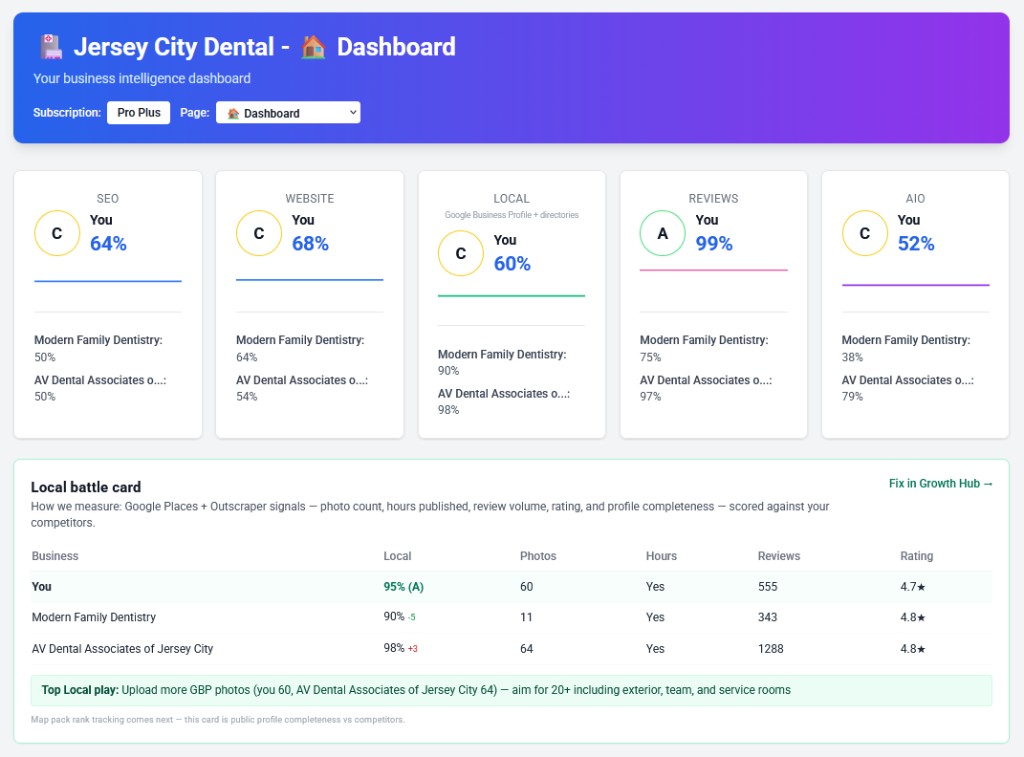
CLIXERA didn't just ask “How good is your website?”
It also asked whether that work was good enough compared with the businesses competing for the same customers.
Not simply
“How good is your website?”
CLIXERA also asks
“Is it good enough compared with the businesses you're competing against?”
Not simply
“Do you have reviews?”
CLIXERA also asks
“How does your reputation compare with your competitors?”
Not simply
“Are you ranking for keywords?”
CLIXERA also asks
“Which searches are competitors winning that you're missing?”
Not simply
“Can AI understand your business?”
CLIXERA also asks
“How does your AI Search visibility and readiness compare with competitors?”
Illustrative findings
Instead of 50 disconnected issues, the business could see the competitive gaps.
The examples below are illustrative. They show the kind of competitive gaps CLIXERA surfaces — not scores or results from a live customer account.
AI Search
Opportunity identified
Competitors communicated services and expertise more clearly across their digital presence.
SEO
Competitive gap
Competitors had stronger visibility around several commercially relevant service searches.
Website
Improvement opportunity
Important service pages could communicate intent and location relevance more clearly.
Reviews
Competitive gap
The business had strong customer sentiment, but competitors demonstrated greater review activity and recency.
Listings
Improvement opportunity
Business information could be strengthened and made more consistent across relevant directories.
This is where the experience changed.
A conventional audit might stop after identifying the problems. CLIXERA asks the next question:
What should we actually do first?
- PRIORITY 1
Improve a high-value service page
Illustrative example
- PRIORITY 2
Address an important competitor keyword gap
Illustrative example
- PRIORITY 3
Strengthen AI-answer-ready service information
Illustrative example
- PRIORITY 4
Improve review activity
Illustrative example
- PRIORITY 5
Correct important listing inconsistencies
Illustrative example
The recommendations became work.
Instead of keeping recommendations inside a PDF, spreadsheet, email or forgotten audit, the business can turn them into a working improvement plan in the Growth Hub.
- Finding
- Recommendation
- Priority
- Task
- Status
- Completion
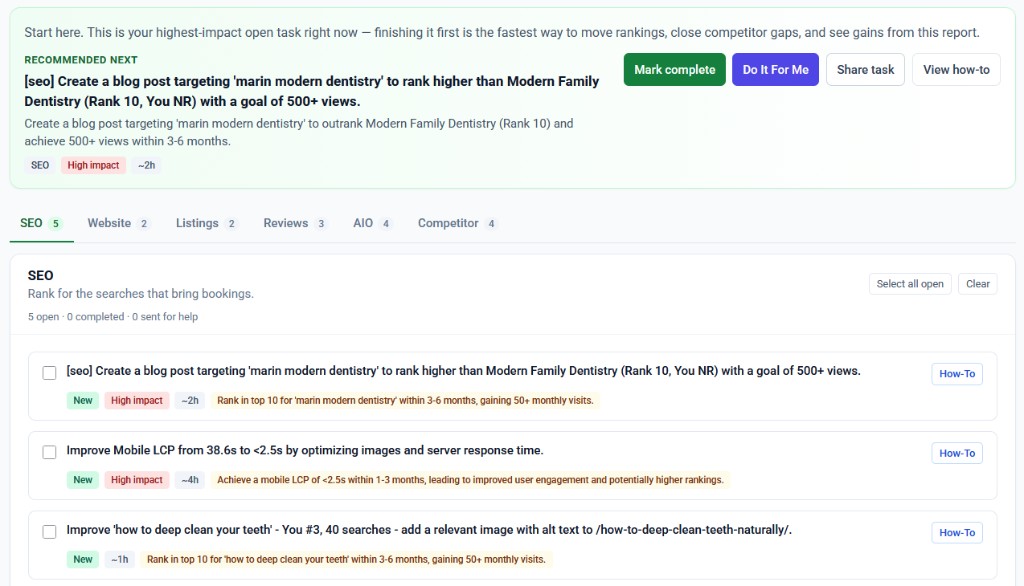
Then the business decides who does the work.
Do It Myself
The owner or marketing person follows the recommendation and completes the task.
Assign It
The task is assigned to an internal team member or existing marketing provider.
Do It For Me
For eligible tasks, the business can request execution support through CLIXERA. Availability depends on the task. Some work may require access, review or approval.
Does this mean businesses stop using ChatGPT or their other tools?
No.
A business can still use ChatGPT, Google Analytics, Search Console, Google Business Profile, advertising platforms, SEO tools, and existing marketing agencies or staff. CLIXERA is not positioned as replacing every marketing tool. Its role is different.
Other tools can help you do the work. CLIXERA helps you understand which work matters most in the context of your competitors.
For example, a business might use CLIXERA to identify an important service-content gap and then use ChatGPT to help brainstorm questions customers ask. CLIXERA provides the competitive context that explains why that work deserves attention. CLIXERA does not control ChatGPT or other third-party platforms.
Then comes the question most marketing reports never answer
Did it work?
After completing priority work, the business can return to CLIXERA and re-run its analysis. The purpose isn't simply to see whether its own score increased. It is to understand whether the position improved, whether competitors improved too, whether the gap closed, where the business is now ahead, where it is still behind, and what deserves attention next.
- Analyze
- Compare
- Act
- Re-test
- Improve
- Repeat
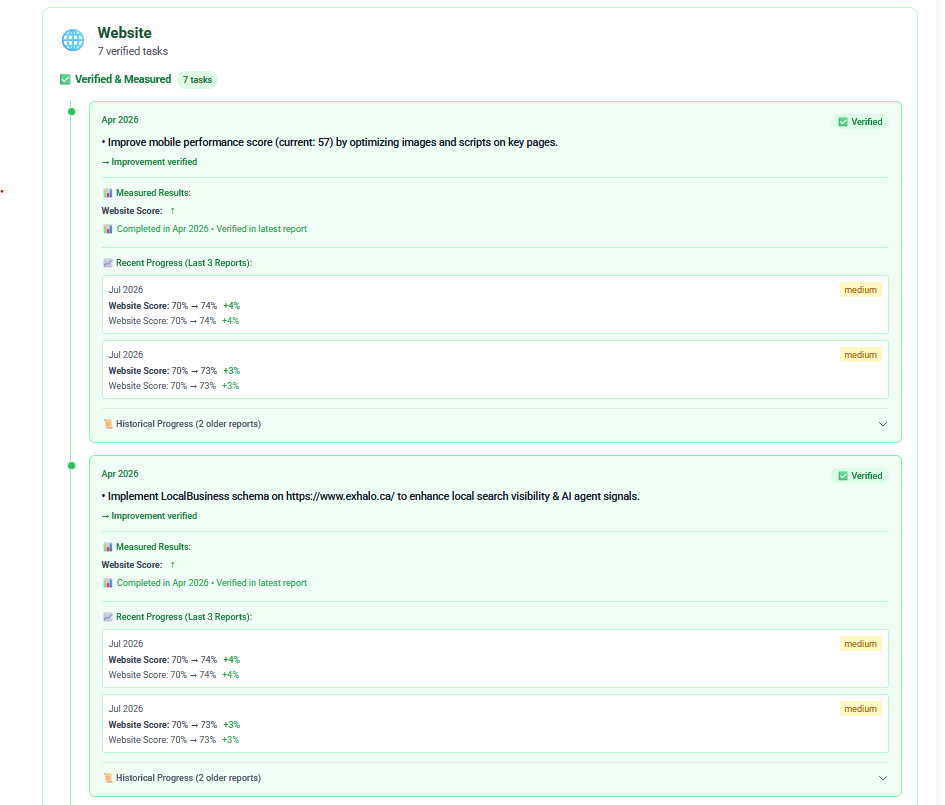
The result: clarity.
From
“There are dozens of things we could improve.”
To
“These are the competitive gaps that matter most, these are the actions we're taking, and this is how we'll measure whether they worked.”
Before CLIXERA, and with CLIXERA
Before CLIXERA
- Multiple tools
- Multiple scores
- Multiple recommendations
- Conflicting priorities
- “What should we do?”
With CLIXERA
- Competitive analysis
- Identify the gaps
- Prioritize the work
- Complete the work
- Re-test
- “Here's what we should do next.”
You don't need to become a digital marketing expert.
Most business owners don't want another marketing dashboard. They want answers to practical questions: Are competitors more visible than us? Why? What should we fix? Who can do it? Did it work? CLIXERA is designed around those questions.
- Tools + data
- CLIXERA competitive context
- Priorities
- Action
- Re-test
- Improvement
How to see where competitors are beating you
Read the gap across search, local, reviews, website and AI visibility.
Continue →SEO competitor analysis for small businesses
Compare search visibility with the competitors that actually matter.
Continue →Now analyze your business.
Choose the competitors that matter to you and see where your business is ahead, where it's falling behind and what deserves attention next.
No credit card required.